
End caps
Heat-shrink end caps provide a reliable seal at pipe ends in district heating and cooling systems, in both new installations and existing networks undergoing refurbishment or repair. They prevent moisture from entering the PUR insulation where the ends of pre-insulated pipes and fittings are exposed in chambers, access shafts, buildings and heat substations.
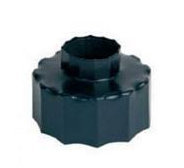
The end caps are made of heat-shrink polyethylene that contracts when heated without melting. Both ends have a layer of heat-resistant sealing adhesive.
Slide the heat-shrink end cap onto the carrier pipe before connecting it to the existing network or internal installation. For reliable shrinkage, ensure adequate overlap between the cap and the HDPE casing. Clean and abrade the surfaces of the casing and steel carrier pipe before shrinking. Use a torch to heat the cap, starting at the protective HDPE casing and working towards the steel carrier pipe.
End caps are supplied in all standard combinations of steel carrier pipe and HDPE casing sizes. They are available for diameters from Ø90 to Ø1000 mm.
The end caps resist thermal ageing, weathering, chemicals and UV radiation, helping maintain the strength and service life of the pipeline.
Rubber wall seals
Rubber wall seals allow district heating pipes to pass safely through building walls, access shafts, concrete ducts and chambers. They protect the pipe at the penetration and provide a seal against water, moisture and dirt.
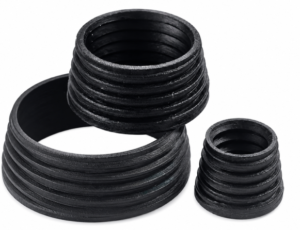
They are made of high-quality, flexible rubber that accommodates axial pipe movement caused by thermal expansion and contraction. This reduces the risk of damage to both the pipe and the structure, helping the district heating installation operate reliably for longer.
Position the rubber rings in the centre of the wall opening. Fill the opening with concrete, taking care to protect the HDPE casing from damage.
Seals can be made in different sizes depending on the carrier pipe diameter and project requirements. Typical available diameters range from Ø90 to Ø1000 mm.
Rubber wall seals resist ageing, weathering and chemical exposure.
Heat-shrink reducing joints
Heat-shrink reducing joints connect pre-insulated pipes and fittings of different nominal diameters in new and refurbished district heating systems. They protect the connection and maintain continuity of the pipeline insulation.
Care must be taken when positioning and fitting the joint between pipes of different sizes. When heated with an open flame, the reducing joint shrinks tightly onto the outer HDPE casing. It forms a watertight, mechanically stable seal that prevents water and moisture from entering the insulation.
Correct sizing, preparation and installation produce a reliable joint and help maintain it over the service life of the district heating system.
Heat-shrink end closures (blind caps)
Heat-shrink end closures, also known as blind caps, terminate and protect the ends of pre-insulated pipes. They seal the end of the pipeline and protect the insulation against water, moisture and other external influences.
They are suitable for temporary and permanent end closures, including where the pipeline ends, is interrupted temporarily or is awaiting further construction.
A blind cap consists of a heat-shrink HDPE sleeve with a sealed cap at one end. When heated, the sleeve fits onto the outer HDPE casing and shrinks to form a tight seal. The steel carrier pipe must be blanked off before the closure is fitted.
Closures are manufactured in different diameters to suit the carrier pipe size.