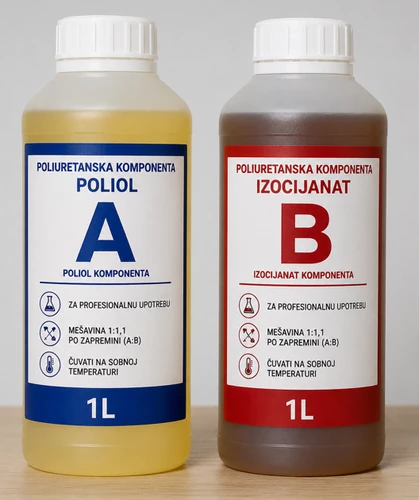
Polyurethanes are widely used polymers because of their versatile applications, mechanical properties and adaptability to different manufacturing processes. A polyurethane system has two main components: polyol (component A, the lighter-coloured component) and isocyanate (component B, the darker-coloured component). Accurate dosing and controlled mixing cause a chemical reaction that forms rigid polyurethane foam.
Applications
Polyurethane components have many applications. Formulations can be tailored for different densities, self-extinguishing properties, reaction times and temperature conditions up to 150°C. They are used in construction, automotive and furniture manufacturing, refrigeration, door and window production, mechanical and industrial equipment, shipbuilding, electrical engineering, footwear, sealant production and transport.
Polyurethane foam is an important insulating material in pre-insulated systems because of its thermal and mechanical properties. Correctly formed foam reduces heat loss and extends pipeline service life. Its closed-cell structure and low specific weight provide mechanical stability and resistance to pressure. A precise A-to-B component ratio and thorough mixing are essential to achieve the required structure, density and quality.
When installing heat-shrink joints in district heating systems, component A (polyol) and component B are mixed in a specified ratio, either manually or by machine. The required quantities depend on the joint size and diameter. Each joint diameter has a specified ratio. Always check the technical documentation for the particular polyurethane system and the manufacturer’s requirements before mixing.
Cyclopentane is used alongside the polyol and isocyanate in the manufacture of pre-insulated pipes, fittings and shut-off valves. It helps produce a fine, closed-cell foam structure with low thermal conductivity.
Mixing, preparation and storage
Accurately measure components A and B, the base and reactive components of the polyurethane system, into a clean, dry mixing vessel. Bring both components to the appropriate working temperature before mixing and use quantities suited to the volume being filled. Mixing can be done by hand or by machine, depending on the application. Once mixed, the components react and form polyurethane foam. Reaction time depends on component temperature, ambient temperature and the specific formulation.
Store the components in their tightly closed original packaging in a dry, ventilated place, away from direct sunlight and moisture, at the temperature specified by the manufacturer. Packaging sizes range from 1 to 250 litres.